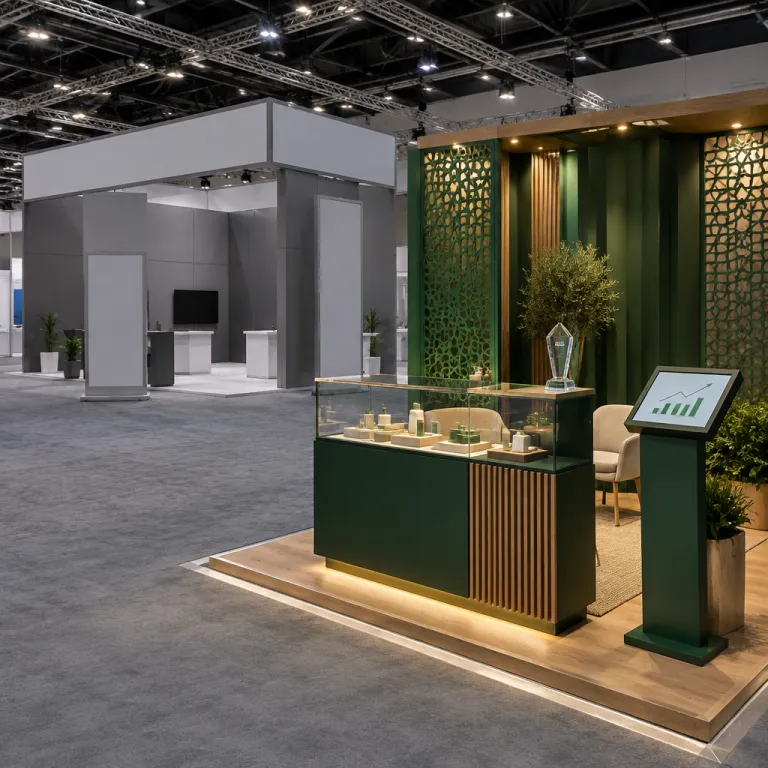
Why a small booth trade show strategy startup can beat a pavilion
A scale up entering a MENA trade show with a 3 × 3 metres small booth often assumes it cannot compete with a corporate pavilion. Yet industry benchmarks on average booth cost and exhibitor behaviour suggest that a focused, compact trade show footprint can generate a stronger pipeline to cost ratio than a large show booth. When your business treats the stand as a revenue engine rather than a décor project, a lean small booth strategy becomes a structural competitive advantage.
On most regional floors, a majority of exhibitors choose compact booths. For example, organiser prospectuses for events such as GITEX Global (Dubai World Trade Centre, 2023 exhibitor manual) and LEAP (Riyadh Front Exhibition & Conference Center, 2024 prospectus) show that standard 9–12 m² stands make up well over half of the floor plan, which means attendees are already trained to evaluate value quickly as they move between displays. A well planned booth design and show display can therefore stand shoulder to shoulder with larger installations when it offers a sharper message, faster access to the product, and a more intentional booth experience for qualified visitors. Smaller spaces also force your équipe to prioritise the products and services that matter for this specific event and to cut anything that does not help attract visitors or close deals.
Public rate cards from Gulf venues indicate that the cost delta between a 3 × 3 metres booth and a multi‑brand corporate pavilion can easily reach a factor of eight to ten once construction, sponsorship, and hospitality are included. For instance, DWTC shell‑scheme packages for GITEX typically start around USD 700–900 per m², while custom double‑deck pavilions with premium sponsorships can exceed USD 6,000–7,000 per m² when all services are annualised. That gap frees small business founders to invest in high quality people, training, and targeted show marketing instead of extra square metres. That shift in budget allocation is where a small booth trade show strategy startup wins, because every dirham moves closer to measurable ROI and away from vanity displays. When you combine that financial discipline with clear booth ideas and a tight follow up process, your brand can outperform much larger neighbours on cost per qualified lead and on speed to revenue.
Choosing the right location on a constrained budget
Location is the first strategic decision for any small booth trade show strategy startup operating in the Arab Emirates. With small budgets, you cannot pay for the most prominent island booth, so you must use data on traffic flow, adjacencies, and show attendees behaviour to create your own high value micro zone. The goal is not to be everywhere in the event but to be exactly where your best trade prospects naturally pass and pause.
On large floors in Dubai or Riyadh, corner booths near café clusters, conference theatre exits, or registration funnels often outperform central pavilions for meaningful conversations. People leaving a keynote or panel are already thinking about specific problems, so a clear show display with one eye catching message and one visible product can intercept that intent. When you align your booth design with those movement patterns, your small booth becomes a natural stop rather than a random stand among hundreds of displays.
Ask organisers for historical heat maps or at least qualitative guidance on visitor flows, then map them against your target segments and your budget. If your business sells industrial products or technical services, being adjacent to a relevant national pavilion or innovation zone will bring more qualified visitors than being buried in a generic hall. This is where a disciplined small trade mindset pays off, because you treat location as a pipeline lever, not a prestige symbol, and you negotiate every metre with clear ROI expectations.
Staffing and training: people over square metres
In the Arab Emirates, the most consistent differentiator between average and top performing exhibitors is not booth size but people quality. A small booth trade show strategy startup that invests in training its équipe to qualify, demo, and close within ninety seconds will routinely outperform a larger show booth staffed by unprepared generalists. Your team is the living display of your brand, and their behaviour will decide whether visitors stay, engage, and convert.
Founders should treat each event as a live sales training lab, with clear scripts, objection handling playbooks, and role specific KPIs for every staff member. One person focuses on greeting show attendees and filtering them, another runs short product demos, and a third schedules follow up meetings, which keeps the booth experience structured even when traffic spikes. This division of roles helps you manage both high intent visitors and curious people without losing either group in the crowd.
To reduce wasted spend, link every staffing decision to a measurable outcome such as qualified leads generated per hour or meetings booked per day. Use a shared CRM or even a structured spreadsheet to capture data in real time, then review it with the équipe each evening to refine your show marketing tactics for the next day. When your small business treats staffing as a performance engine rather than a cost centre, the 3 × 3 metres space becomes a high quality revenue machine that rivals any corporate pavilion.
The magnet method: one bold message, zero clutter
Most corporate pavilions in the region try to show everything at once, which leads to visual noise and diluted messages. A small booth trade show strategy startup cannot afford that confusion, so it must apply the magnet method, where one bold visual and one clear sentence pull the right people into the booth. This approach turns your limited display area into a focused signal that cuts through the event chaos.
Start by defining a single promise that matters for your best trade prospects, such as cutting a specific cost, accelerating a process, or opening a new market. That promise becomes the core of your booth design, printed in large, legible type at eye level, supported by one hero product or one simple digital demo rather than a wall of brochures. When visitors can understand within three seconds who you serve and what problem you solve, they self qualify and step in willingly.
Everything else in the show booth should support that magnet, from the colours and lighting to the interactive elements and seating. Avoid cluttered displays, long text blocks, and multiple competing product messages, because they slow down decision making and reduce the number of people you can engage per hour. In a MENA context where attendees often have tight schedules and many social obligations, this clarity becomes a competitive weapon for any small business that wants to attract visitors efficiently.
Designing eye catching yet efficient show displays
Minimalist booth design does not mean boring or generic, especially in visually rich events like GITEX, LEAP, or Big 5. For a small booth trade show strategy startup, the objective is to create an eye catching show display that signals innovation and professionalism without overwhelming the senses. You want visitors to feel invited, not intimidated, when they approach your stand.
Use one strong visual anchor such as a large product image, a clean 3D logo, or a looping video that shows your solution in action within a Gulf specific context. Surround that anchor with plenty of negative space, which makes the brand and the product easier to read from a distance and helps your displays stand out against the busy background of the event. High quality materials on a small footprint often cost less than low grade materials spread across a large pavilion, yet they communicate far more credibility.
Lighting is another underused lever for small budgets, because a well lit show display can make even a compact booth feel premium. Combine warm front lighting for people with cooler accent lighting on the product to guide the eye naturally from the message to the demo. When your booth ideas respect both aesthetics and human behaviour, you transform a simple 3 × 3 metres space into a magnetic micro environment that keeps visitors engaged long enough for your équipe to qualify them properly.
Managing flow and qualification inside a compact space
Once your magnet attracts visitors, the next challenge for a small booth trade show strategy startup is managing flow inside the limited area. Without a clear process, you risk crowding the entrance, losing high intent people, and turning your booth experience into a bottleneck. The layout must therefore guide show attendees through a simple journey from curiosity to qualification to next step.
Place your greeting position slightly outside or at the edge of the booth, so staff can intercept passers by without blocking those already engaged. Inside, reserve the deepest part of the space for short demos or deeper conversations, using a small counter or high table as a natural boundary between quick chats and serious discussions. This separation allows your équipe to handle multiple visitors simultaneously while keeping noise and movement under control.
To fix the common qualification bottleneck, implement a structured question set that your staff uses consistently, then capture answers immediately in your CRM or lead app. For a practical framework on this, review internal guidance on how to fix the qualification bottleneck, which explains why your best leads often leave after ninety seconds if you lack a clear process. When you combine that discipline with a thoughtful layout, your compact booth can process more qualified visitors per hour than many sprawling corporate stands.
Pre show strategy: filling your calendar before day one
The most effective small booth trade show strategy startup in the Arab Emirates treats the event as the middle of a campaign, not the beginning. By the time the doors open, your team should already have a calendar filled with pre scheduled meetings from target accounts, investors, and partners. This pre show discipline neutralises the advantage of a large pavilion, because meetings happen at your 3 × 3 metres space regardless of its size.
Start three to four weeks before the event by building a focused outreach list from your CRM, LinkedIn, and the organiser’s directory where available. Segment contacts into existing customers, warm prospects, and new targets, then send tailored invitations that explain why meeting at your small booth will create concrete business value for them. Use clear time slots, a simple booking link, and a promise of a specific product demo or discussion topic to increase acceptance rates.
In parallel, coordinate with your marketing équipe to run targeted social media campaigns on LinkedIn and X, using the event hashtag and location based filters. Share short videos of your show display setup, teaser images of the product, and posts that highlight the problems you solve for Gulf based companies. When people see that your brand is active and relevant before the event, they are more likely to add your booth to their personal route through the halls.
Leveraging startup zones and innovation pavilions
Major MENA events such as GITEX, LEAP, and Big 5 increasingly allocate dedicated startup zones and innovation pavilions. For a small booth trade show strategy startup, these zones are force multipliers, because they cluster high growth companies and attract visitors who are explicitly looking for new ideas and disruptive products. Being part of such a cluster can offset the visual dominance of corporate pavilions elsewhere on the floor.
When you apply for these zones, position your business clearly as a scale up with a validated product and a strong pipeline, not as an early stage experiment. Organisers want to curate credible brands that will impress investors, government buyers, and enterprise attendees, so emphasise your existing customers, case studies, and regional relevance. Once accepted, coordinate with neighbouring exhibitors to cross refer visitors and to share insights about which show attendees are most engaged.
Within these innovation areas, your booth design should still follow the magnet method, but you can lean more heavily on interactive elements such as touchscreens or VR demos. These tools increase dwell time and help visitors experience your products and services in a tangible way, which is especially powerful for complex B2B solutions. For more detailed guidance on how to turn foot traffic into qualified pipeline through stand design that converts, study specialised internal resources on stand design that converts and adapt the principles to your specific sector.
Aligning sales, marketing, and leadership before the event
Misalignment between sales, marketing, and leadership is one of the main reasons small booths underperform at MENA trade shows. A small booth trade show strategy startup cannot afford internal confusion, because every interaction must serve a clear pipeline objective. The remedy is a structured exhibitor briefing that forces all stakeholders to agree on goals, messages, and processes before anyone travels.
In that briefing, define your primary KPI such as qualified leads, meetings, or signed contracts, and translate it into daily targets for the équipe. Clarify which products and services you will highlight, which personas you want to meet, and which objections you expect to handle, then document everything in a concise playbook. This document becomes the reference for booth behaviour, lead capture rules, and post event follow up responsibilities.
To operationalise this alignment, use a practical exhibitor briefing framework that explains how to align sales, marketing, and leadership before a MENA trade show. Share it with your team, adapt it to your context, and review it together in a live session before the event. When everyone understands the strategy and their role in it, your small booth functions as a coordinated revenue unit rather than a loose collection of individuals.
Budgeting for impact: where a 3 × 3 metres booth should spend
For a small booth trade show strategy startup, the budget is not just a constraint; it is a design tool. The relatively low cost of a 3 × 3 metres booth compared with a corporate pavilion allows you to reallocate funds toward elements that directly influence revenue. A disciplined budget template ensures that every dirham supports either attracting visitors, converting them, or accelerating post event deals.
Begin by fixing a total budget that you can afford to lose without endangering cash flow, then work backwards from your target pipeline and expected conversion rates. Allocate a modest share to the physical structure and graphics, focusing on high quality but simple materials that support your magnet message and booth ideas. Reserve a larger portion for people costs, including travel, accommodation, and pre event training, because well prepared staff will generate far more business than extra furniture or decorative displays.
Do not neglect technology and data capture tools, which are essential for a modern booth experience in the Arab Emirates. Budget for a reliable lead scanning app, a simple interactive display for demos, and perhaps a small screen to run looping case study videos. These investments help your équipe handle more visitors efficiently and ensure that no qualified contact leaves without being captured in your CRM.
Sample allocation for a high ROI small booth
While exact numbers vary by city and sector, a practical allocation for a small booth trade show strategy startup might dedicate roughly one third of spend to the stand, one half to people, and the remainder to marketing and follow up. Within the stand category, prioritise a clean show display, readable signage, and comfortable flooring over complex structures or heavy furniture. This keeps setup simple and reduces logistical risk, which is especially valuable for first time exhibitors in the region.
As a simplified example, a startup with a total budget of AED 90,000 for a major Gulf event might allocate around AED 30,000 to the stand (structure, graphics, basic furniture), AED 45,000 to people (travel, accommodation, per diems, and training for a three to four person équipe), and AED 15,000 to marketing and follow up (targeted ads, content production, and post show campaigns). These figures are illustrative rather than prescriptive, but they show how a compact booth can still support a serious commercial effort.
For marketing and follow up, allocate funds to targeted social media ads, high quality digital content, and a structured post event email sequence. Rather than printing large quantities of brochures, invest in a simple QR based content hub where visitors can access product information on their phones. This approach reduces waste, aligns with sustainable practices, and gives you better données on which materials actually influence deals.
Measuring ROI and learning from each event
No small booth trade show strategy startup can improve without rigorous measurement of results. Before the event, define a small set of KPIs such as number of qualified leads, meetings held, proposals sent, and revenue closed within a defined durée. These metrics allow you to compare different shows, refine your budget, and decide which events deserve repeat participation.
During the event, capture data consistently for every interaction, including basic profile information, interest level, and next step. Use simple tags to distinguish between visitors who came through pre show outreach, walk ins attracted by the display, and referrals from partners or neighbouring exhibitors. This segmentation helps you understand which parts of your show marketing and booth design are actually driving business outcomes.
After the event, review performance with your équipe, focusing on what worked, what failed, and what should change for the next trade show. Compare your pipeline to cost ratio with that of larger competitors when possible, and use those insights to strengthen your narrative with investors and internal stakeholders. Over time, this learning loop turns your small business into a highly efficient exhibitor that consistently outperforms corporate pavilions on ROI.
Brand, content, and social media: amplifying a compact presence
A small booth trade show strategy startup in the Arab Emirates must think beyond the physical stand and treat the event as a content factory. Every conversation, demo, and question from visitors can become raw material for marketing assets that extend your reach far beyond the show days. This mindset allows a small brand to punch above its weight in regional and global conversations.
Before the event, prepare a simple content plan that lists the types of assets you will capture on site, such as short customer interviews, product demo clips, or behind the scenes footage of your équipe setting up the booth. Assign clear roles so that one person is responsible for filming, another for quick editing, and a third for posting on social media channels. This structure ensures that content creation does not interfere with serving attendees at the stand.
During the event, share real time updates that highlight meaningful interactions, new ideas small that emerge from discussions, and any recognition your brand receives from organisers or partners. Tag the official event accounts and relevant influencers to increase visibility among show attendees who may not yet have visited your booth. When people see your activity online, they are more likely to seek out your stand in person, which reinforces the impact of your physical presence.
Crafting a consistent brand narrative across channels
Consistency between your booth design, your digital channels, and your sales conversations is critical for building trust in the MENA B2B ecosystem. A small booth trade show strategy startup should articulate one clear narrative about who it serves, what problem it solves, and why its solution is different. That narrative must appear in your show display, your website, your pitch deck, and your social media posts.
Use the same core message that appears on your booth graphics as the headline for your event landing page and your outreach emails. Align your product demos with that message, focusing on two or three key use cases that matter most for regional buyers. This repetition helps visitors remember your brand even after they have walked past hundreds of other displays and conversations.
When your narrative is coherent, every interaction at the event reinforces the same mental image of your business in the minds of attendees. Investors see a focused team with a clear strategy, customers see a reliable partner, and partners see a complementary player in the ecosystem. Over time, this consistency turns your small booth into a recognisable signal at multiple trade shows across the Arab Emirates and the wider MENA region.
Turning visitors into advocates after the event
The real value of a small booth trade show strategy startup emerges in the months after the event, when leads convert and relationships deepen. To maximise this value, you must treat every visitor as a potential advocate, not just a potential buyer. That means designing follow up sequences that educate, support, and involve people in your journey.
Segment your leads based on their interest level and role, then send tailored follow ups that reference the specific booth experience they had with your équipe. Share relevant case studies, product updates, or invitations to small online briefings that continue the conversation started at the show. This personalised approach signals respect for their time and increases the likelihood of long term fidélité.
Encourage satisfied customers and partners to share their experience of your brand on social media or in short testimonial videos that you can use at future events. When new visitors see familiar faces and credible stories on your show displays, they approach your booth with higher trust and stronger intent. In this way, each trade show builds on the previous one, compounding the impact of your small booth and reinforcing your position against much larger corporate pavilions.
FAQ
How can a 3 × 3 metres booth compete with a large pavilion at MENA trade shows ?
A 3 × 3 metres booth can compete by focusing on clear messaging, targeted pre show outreach, and disciplined lead qualification. When a small booth trade show strategy startup invests in high quality staff training and a strong booth design, it often achieves a better pipeline to cost ratio than larger exhibitors. The key is to treat every square metre and every interaction as a revenue asset, not as decoration.
What is the most important investment for a small booth at events in the Arab Emirates ?
The most important investment is usually in people rather than in structure. Well trained staff who can quickly qualify visitors, run concise demos, and schedule follow ups will generate more business than expensive furniture or complex displays. For a small booth trade show strategy startup, this focus on human performance is the fastest path to outperforming corporate pavilions.
How should a startup choose its booth location on a limited budget ?
A startup should prioritise locations near natural traffic nodes such as theatre exits, café areas, or relevant industry clusters. These spots often cost less than headline positions but still bring a high volume of qualified attendees past your show display. By analysing traffic flow and aligning with target segments, a small booth trade show strategy startup can secure a high impact location without overspending.
What metrics should be tracked to measure trade show ROI for a small booth ?
Key metrics include number of qualified leads, meetings held, proposals sent, and revenue closed within a defined period after the event. Tracking the source of each lead, such as pre show outreach or walk in traffic, helps refine future strategies. With this data, a small booth trade show strategy startup can compare events, optimise budgets, and build a strong case for continued participation.
How can startups in the Arab Emirates use social media to support their trade show presence ?
Startups should use social media before, during, and after the event to share focused content that highlights their booth, products, and customer stories. Real time posts with the event hashtag help attract visitors to the stand, while post event content nurtures relationships and showcases results. When integrated into a broader small booth trade show strategy startup plan, social channels significantly amplify the impact of a compact physical presence.
Sources
Pure Exhibits ; Oser Communications ; Ace Displays ; organiser prospectuses and public rate cards from major MENA trade shows, including GITEX Global exhibitor manuals (Dubai World Trade Centre), LEAP exhibitor prospectuses (Riyadh Front Exhibition & Conference Center), and Big 5 Dubai pricing guides.